…Sprung

Coltsfoot are blooming, buds on the red maples are bursting, pussy willows are beyond, painted turtles are out sunning, and the skunk cabbage looks fully mature.  Spring is here!  It’s like once the snow melted Mother Nature is trying to catch up.

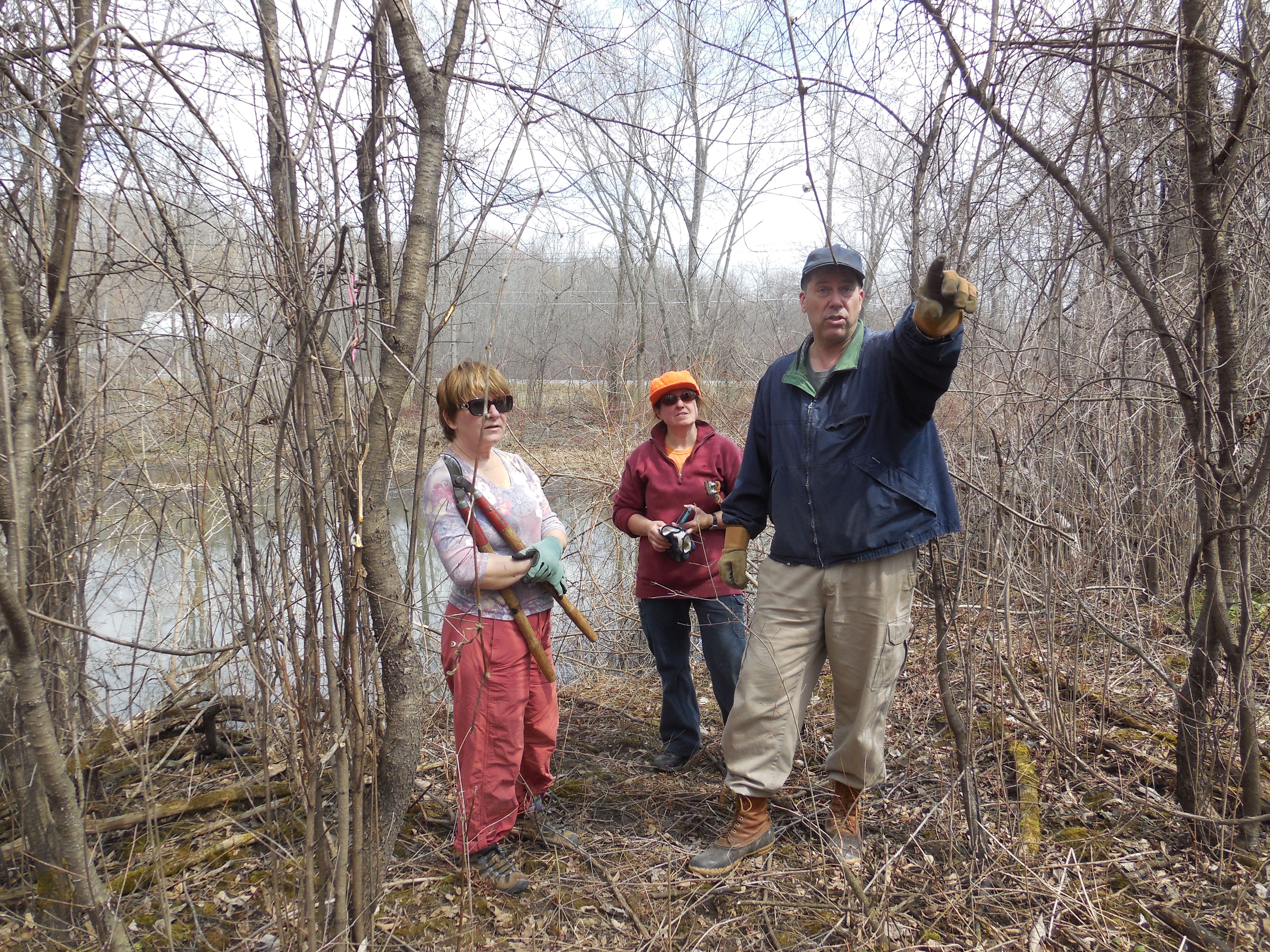
Sue Lasker, Maryanne Mackey and Paul Olund on Canal Clean Sweep.

A trail cleanup crew discusses what seems to be part of the early “Clinton’s Ditch” north of the Clutes Dry Dock.

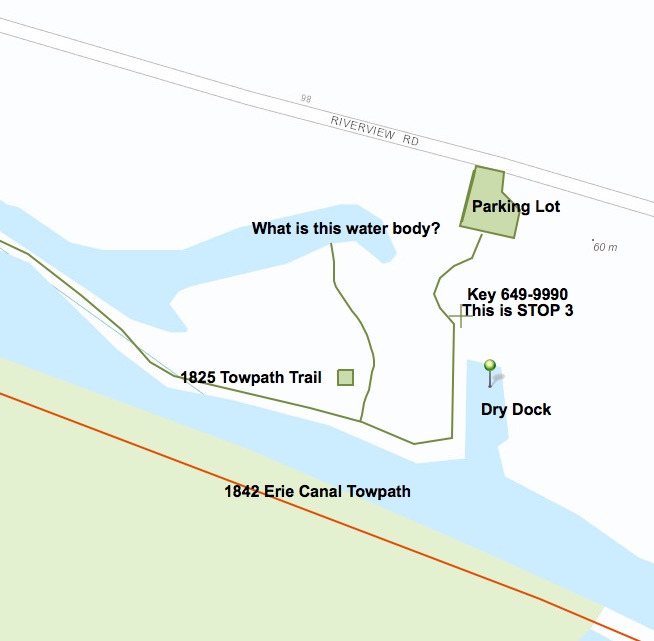
While participating in the Canal Clean Sweep event, a hardy group of Friends of the Mohawk Towpath Byway including Paul Olund, and neighbors Maryanne Mackey and Susan Lasker rediscovered a “back water” north of Clutes Dry Dock.  The waterbody is elongated in an east west direction complete with what seems like a distinct towpath on the south side.  Was this part of the original 1825 Erie Canal or and early excavation for a dry dock?

Map of Clutes Dry Dock

What is this water body? Is there a Byway story here?

This type of exploration would not be possible after the vegetation fully emerges, because of the buck thorn, honey suckle, multi floral rose, and other thick, emergent undergrowth.

Get out there and make your own discoveries along the Mohawk Towpath Byway as spring returns to the northeast.  A hardy thank you to all of those who were up and at it for explosion of Canal Clean Sweep events this weekend.

Apple Blossom Festival

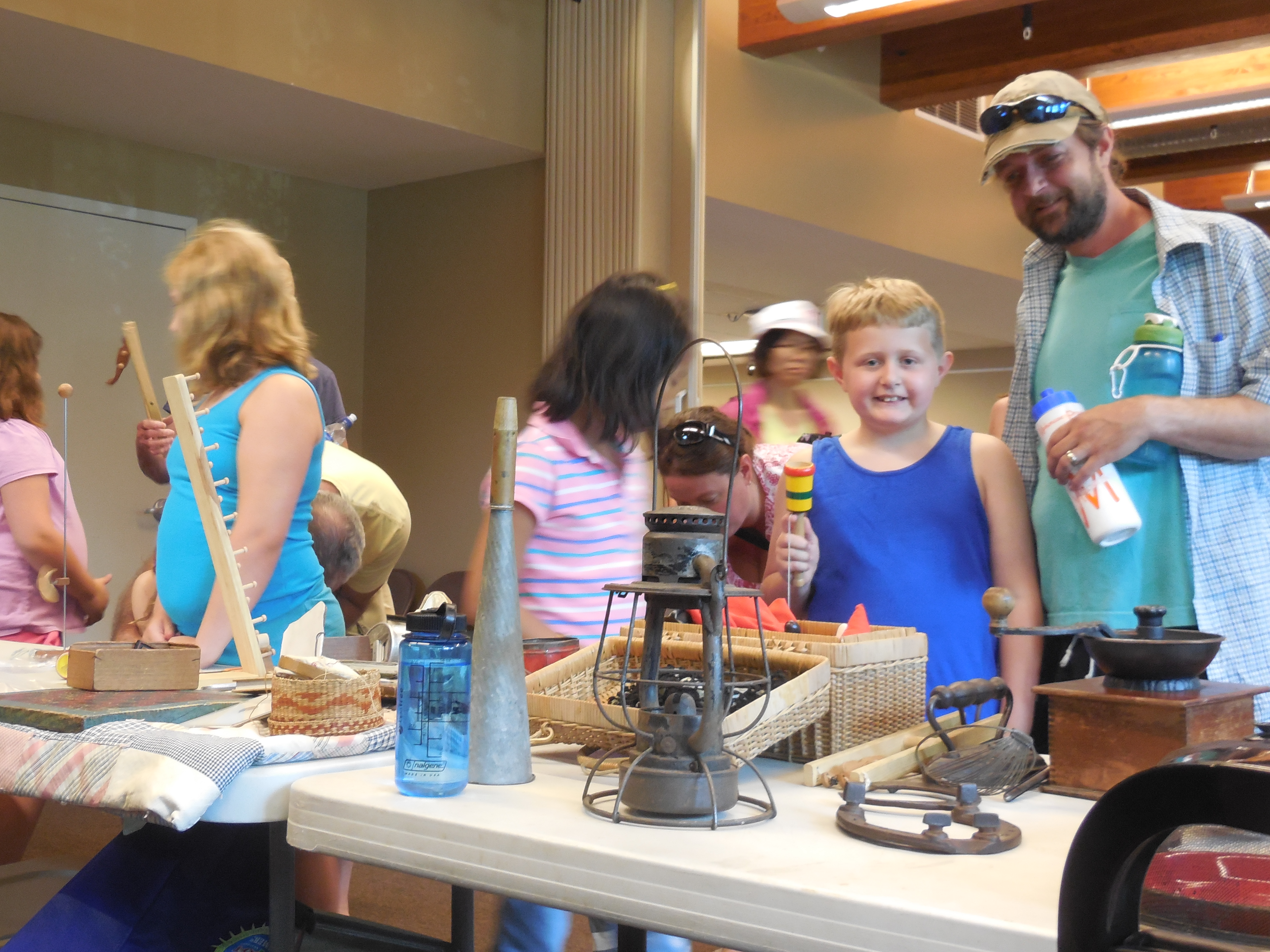
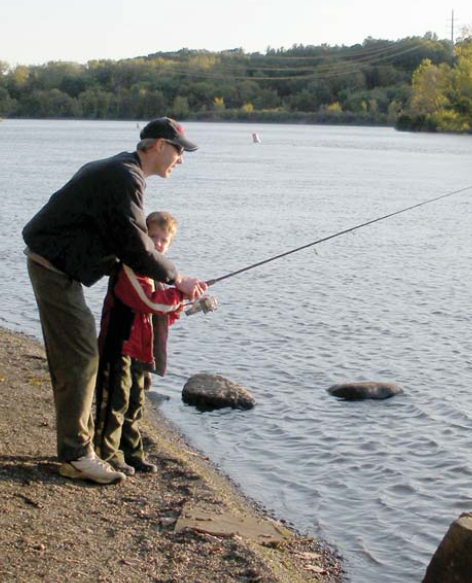
The Mohawk Towpath Byway in conjunction with the Rotary Club of Shenendehowa and Riverview Orchards will host a day of family fun at 660 Riverveiw Road, Rexford on Saturday, May 9. There will be nature hikes, cooking demonstrations with local ingredients, local food, a working model of a canal lock, hay rides, childrens games that were a part of our heritage, giant bubble blowing, ice cream eating contest, and much more.

The Apple Blossom Festival starts at 9 AM and wraps up at 4 PM.

The event is free and food will be available at reasonable prices.

Meeting Agenda

There is a meeting of the Friends of the Mohawk Towpath Byway on Tuesday evening, April 14 at 7 PM at the historic Grooms Tavern, at the intersection of Grooms and Sugar Hill Roads in Clifton Park (Rexford mailing address).  The meeting is open to the public and you are invited!  

The agenda…  coming soon.

Migration

The ice on the Byway’s water bodies is starting to yield to the warm spring sun. It is said that one of the reasons that the Erie Canal was constructed on the north side of the Mohawk River was because the spring sun warmed the waters on the north side of the valley first. Even though it has been a cold, snowy winter and our vegetation is at least two weeks behind the usual, there are larger areas of open water becoming apparent.

As these open areas of water grow the spring bird migration starts. Today’s beautiful azure skis provided a unique backdrop for a flight of snow geese high over the Byway corridor. I have only seen such a sight once in my life as I happened to be traveling down the Lake Champlain Valley one fall day about 15 years ago. I saw a flock of snow geese lit by the setting sun against a grey sky. That flock, as impressive as it was, was southbound and warned of the coming Arctic Air. I was also viewing the flock from a moving vehicle which muffled any sound they made.

Today I was on foot and heard the flock before I saw their majestic flight. I got the whole show with the warming sun over my shoulder. I know a picture is worth a thousand words, but no picture could capture this experience.

As the remaining accumulated snow drifts continue to melt and the surface ice continues its retreat I will be looking for the red maple buds to open, skunk cabbage to emerge, and the promising yellow coltsfoot. Get out there and see what is emerging today even if it’s just the moss in the sidewalk joints. Don’t forget your boots as you step off the sidewalk. Trails are muddy as they melt the frost beneath.

Spring is coming to renew us all.

Telling the Byway Story

One of our more successful events for attracting attention to the Mohawk Towpath Byway is at the Adirondack Sports and Fitness Summer Expo. Held the first full weekend in March, as people are making plans for the warmer months, the Expo attracts many regional recreational enthusiasts. This past weekend was no exception.

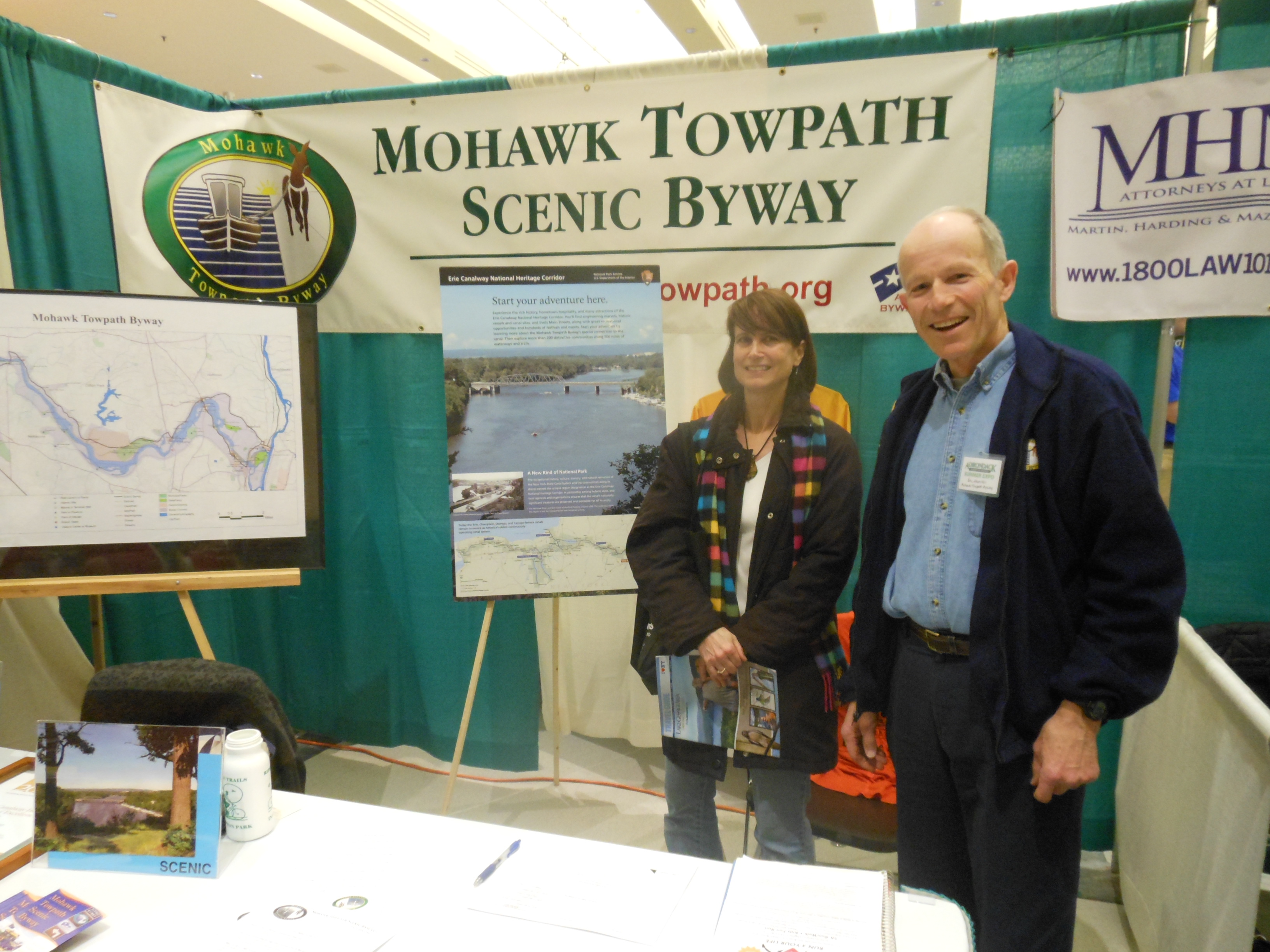
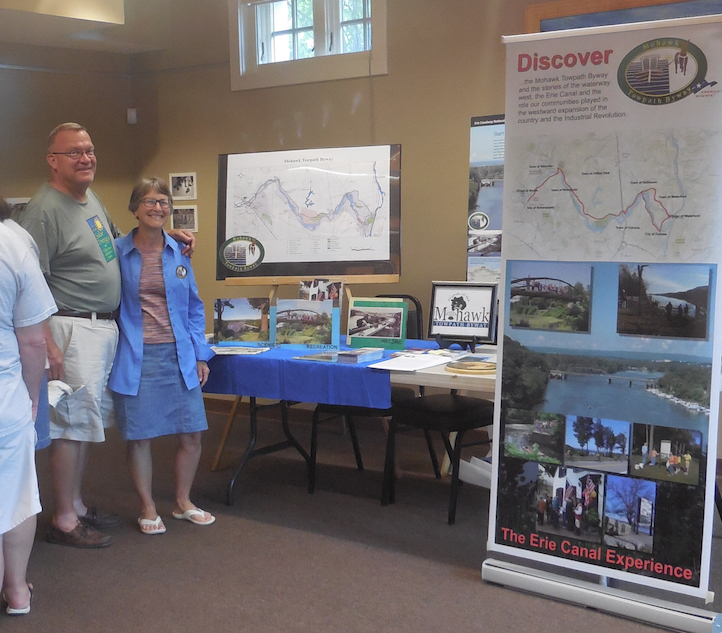
Byway Booth

Harold and Henrietta O’Grady answer questions about the Byway’s events. Photo by Paul Olund


Many thanks to Maryanne Mackey, Susan and Alan Lasker, Henny and Harold O’Grady, Joanne Coons, and Paul Olund for their excellent and enthusiastic help this weekend!

Looking to Warmer Weather

Look for the Friends of the Mohawk Towpath Byway this weekend at the Adirondack Sports and Fitness Summer Expo at the Saratoga Springs City Center. The Expo is open from 10 AM until 5 PM on Saturday, March 7 and from 10 AM until 4 PM on Sunday, March 8. Features will include all kinds of ideas for summer fun from kayaking and cycling to birding. Find out where along the Byway you can take part in all of these activities.

We will also have a calendar of major festivals and events during the summer months, a brochure describing the Byway’s self guided tour, and membership information if you’d like to join the dynamic organization that is bringing major recreational improvements to the Mohawk Towpath Byway.

Our Booth

The Director of the Erie Canalway National Heritage Corridor visited the Byway’s booth in a previous year.

Dam Construction at Vischer Ferry

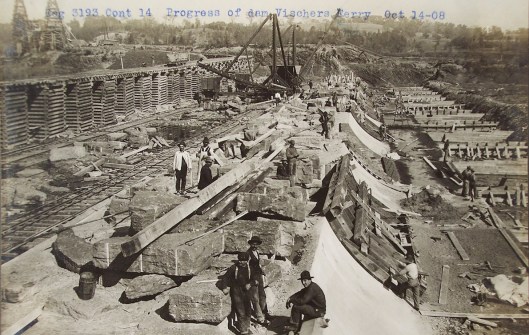
Construction of the dam across the Mohawk River at Vischer Ferry started during the construction season of 1907.  By the end of the following construction season a coffer dam had been constructed between the south side of the river to Goat Island and construction of this segment of the dam was well under way.
Construction in the south segment of the dam in 1908..
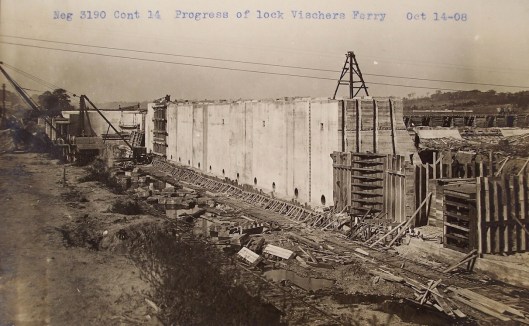
Note that the horizontal top of the berm and towpath of the Enlarged 1842 Erie Canal can be seen below the tree line on the north side of the river in the right background.    This photograph must have been taken from the top of the upstream head wall of lock 7 as shown in the back ground of the following photograph. North wall of Lock 7 under construction in Oct 1908. Photograph from the Mycon Collection
Construction of the north wall of Lock 7 is taking shape in this October 1908 photograph. In the foreground we can see form work for the down stream gate pocket under construction. The forms for the upstream gate pocket have not been removed. In the background to the left we see a couple of buildings of a large complex of shops and construction support buildings. In the right background one can see three barges on the 1842 Enlarged Erie Canal just above the coffer dam.
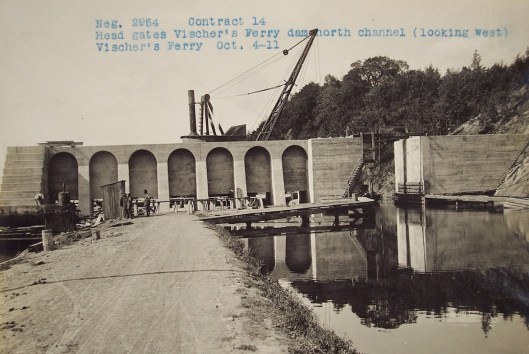
Construction of the early Power house.
Construction of Lock 7 is and the dam is functionally complete in this October 1911 photograph. Progress on the construction of the early power house slices through the 1842 Enlarged Erie Canal. The towpath of the canal is seen in the foreground. This construction promptly brought an end to any remaining Erie Canal traffic that used draft animals as propulsion. All traffic in 1911 was using steam power.
An interesting footnote to this construction is added a century later. During the flooding that occurred after Hurricanes Irene and Lee the earth dam between Lock 7 and the bank of the Mohawk on the opposite side of the river had to be reinforced on an emergency basis when seepage was noted undermining that small portion of the dam. Thousands of yards of fill was brought in and placed on the toe of this earthen portion of the dam. Had this part of the dam failed the downstream flooding in Vischer Ferry all the way to Crescent would have been much worse. With this emergency fill Lock 7 was again functional by December of the same year.

Greetings

XmasHappy Holidays to the Volunteers that make the Mohawk Towpath Byway what it is today and to all of those who live, work and play within the Byway corridor.

May we all have a prosperous, exciting and rewarding
Happy New Year!

We will be celebrating our tenth year as one of America’s Byways® in 2015. Join in our festivities starting with a Family Moonlight Ski on the evening of January 1, 2015. If snow conditions do not permit we will try again on January 29, 2015.

Lock 7 Dam Overlook

View from OverlookStand at the Lock 7 Dam overlook at the foot of Sugar Hill Road.  Can you visualize what this view must have looked like to native peoples?  You would see Goat Island in the middle with rapids cascading down shale bedrock on either side of the island.  Many of our present day town roads follow old trails used by native peoples.  There is reason to believe that Riverview Road follows one of these pre-European historic trails west and Sugar Hill Road follows another north.

Glacial ice and meltwater played a major role in the geologic and landform development of the Mohawk Valley.  Prior to the last glaciation, the Mohawk drained south from Schenectady and joined the Hudson River near Coeymans, NY. Following glaciation, this route was buried by glacial sediments and a much larger ‘Iromohawk’ river drained through the valley. For a period of a few hundred years, while the St. Lawrence Lowland was blocked with ice, the Iromohawk conveyed the drainage of the Great Lakes and the meltwater of the eastern Laurentide ice sheet through the valley.  The Iromohawk cut wide channels across the Hudson-Mohawk Lowland, deposited cobble-sized gravels in many locations east of Little Falls, and eroded bedrock between Rexford and Cohoes, forming the route the modern river follows today.  – The Mohawk River Action Agenda, NYSDEC, 2012

Under Chapter 532, Laws of 1922, the Superintendent of Public Works was authorized to develop the potential water power at the Barge Canal dams located at Crescent and Vischer Ferry. All Contract work at both plants was completed in 1925. The equipment at each plant includes two 2800 Kw, 0.8 power factor, 3 phase, 60 cycle, 2300 volt, 90 rpm vertical generators, each directly connected with a 4.000 hp, reaction-type, Francis turbine. The generators were furnished by General Electric. Both power plants were officially conveyed to the Power Authority of the State of New York on 13 March 1984 by the New York State Department of Transportation. In 1987 the Power Authority added 6,000 kilowatts of capacity to each plant, more than doubling their capacity. The additional electricity replaced about 3,200,000 gallons of oil annually. The vertical turbines were purchased from Voith Hydro of York, Pennsylvania. Both the Crescent and Vischer Ferry dams and powerhouses were rehabilitated at this time.